There is a specific frustration that every AI RPG player has felt at some point.
You spend two hours building a campaign. Your character has a backstory. There is an NPC you helped in the first act who owes you something. A companion who is starting to trust you after a rough start. A plot thread you deliberately left unresolved because you wanted to come back to it.
You close the app. You come back the next day. The AI has forgotten everything.
Not partially. Not approximately. Everything. The NPC does not know you. The companion has no memory of what you went through together. The world has reset.
That experience pushed a lot of players away from the category entirely. And honestly, it was a fair reaction. A game that forgets itself is not a game. It is a demo that loops.
That problem has now been solved. Not by every platform, but by at least one. And the difference in what is possible as a result is significant enough that it is worth understanding properly.
Why Memory Was So Hard to Get Right
The obvious solution is to store the conversation and replay it at the start of every session. That is what most platforms tried first.
It works for short campaigns. Once a campaign runs across ten or fifteen sessions, the conversation history becomes too long to process efficiently. The AI starts losing the oldest details, which are often the most important ones. Decisions from session one disappear exactly when they should be producing consequences in session eight.
Summarization was the next attempt. Compress the history into a shorter block and prepend it each time. Better, but summaries lose specificity in ways that matter. A summary that says 'the player helped a guard' is not the same as knowing the guard's name, what the player gave up to help him, and that his sister now works in the city watch and owes the player a favour.
Details are what make a campaign feel alive. Summaries flatten them into noise.
The solution that actually works is structured extraction. After each session, a separate process reads what happened and pulls out discrete facts, tagged by entity and type. Character relationships, decisions with consequences, NPC states, quest threads, location history. These get stored as individual memory entries rather than as prose, and referenced selectively at the start of each new session based on what is relevant to the current scene.
That is the architecture that changes what is possible. And it is what Questsmith built.
What 500 Memories Actually Means in Practice
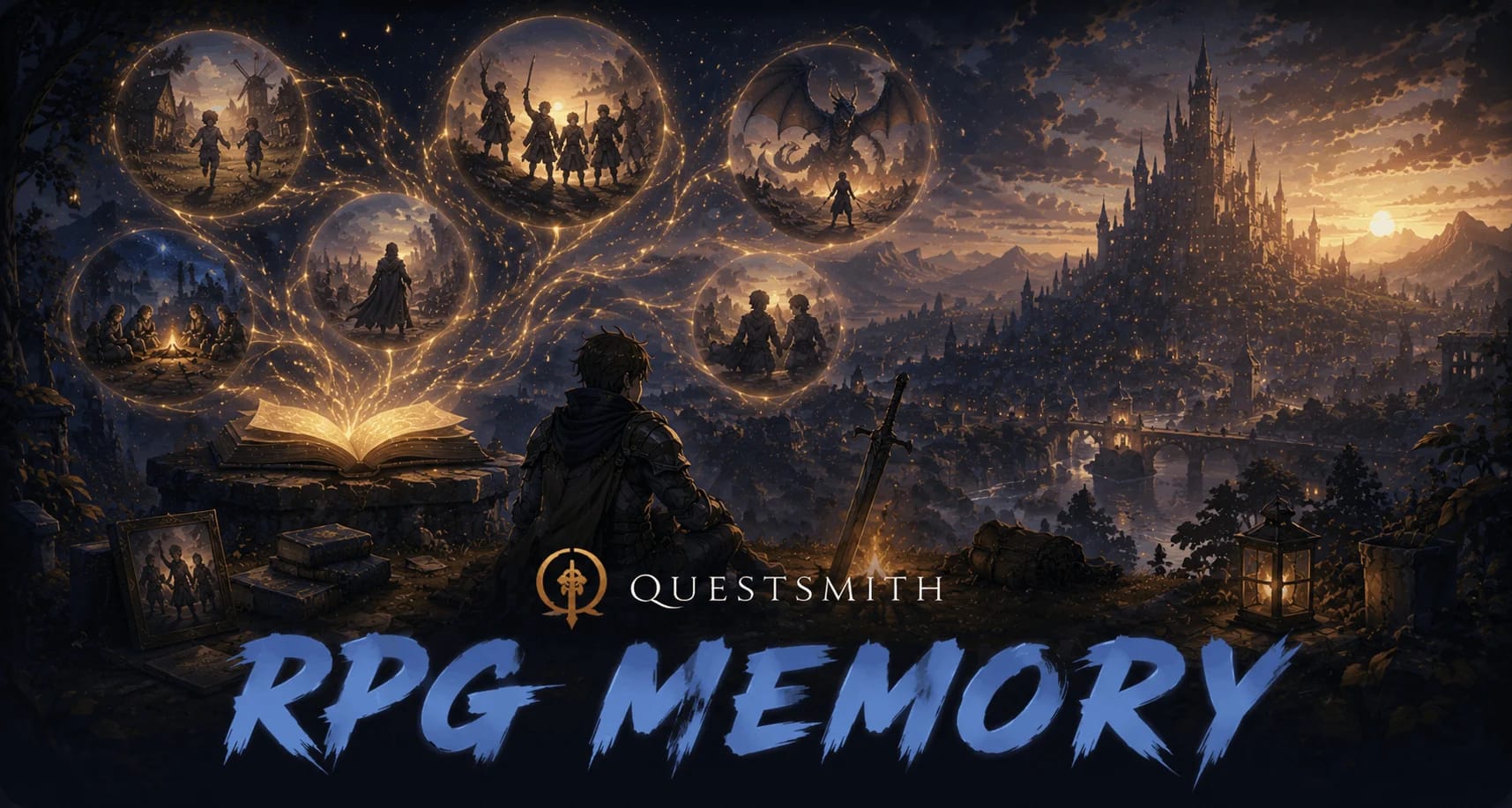
Questsmith tracks up to 500 individual memory entries per adventure.
Most players do not hit that ceiling. A long campaign running across several weeks builds up around 200 to 300 entries. What matters is not the number but what those entries contain.
Each entry is a specific fact. Not 'the player made friends with a guard' but something precise enough to be actionable when the AI is generating the next scene. The NPC's name. The nature of the relationship. What the player did to earn it. Whether there is an outstanding debt.
When you come back after three days away, the AI does not need you to paste in a recap. It already has the relevant facts loaded. The session picks up with the context intact.
The difference this produces in actual play: an NPC from week one shows up in week four and behaves consistently with what happened between you. A choice you made in session two that seemed minor at the time surfaces as a consequence in session six. A companion whose trust you have been building since session one acts differently from one you have been neglecting.
None of that is possible without memory architecture that survives between sessions at this level of granularity. And none of it feels like a game feature once it is working. It just feels like a story that is actually alive.
The RPG System That Makes It a Game, Not Just a Story
Memory solves the continuity problem. It does not by itself make something an RPG.
Questsmith builds a full RPG system on top of the memory foundation.
Four character stats — Combat, Magic, Stealth, and Social — that affect what your character can actually do in any given scene. A rogue with high Stealth and low Combat plays differently from a fighter. Not just in description. In outcome. Checks fail when the stat is genuinely low. The story adjusts around those failures in ways that carry forward.
D20 dice rolls with a win-chance preview before you commit. That one feature changes decision-making entirely. Knowing you have a 28% chance before you attempt the bluff makes the attempt feel like a real risk rather than a narrative choice. When it fails, the failure was earned.
Live health and mana tracking during combat. Multiple enemies with their own HP bars. A quest log that updates automatically as the story moves. Scene awareness that tracks location, time of day, and atmosphere across sessions.
The companion system sits on top of all of this. Your companion has a persistent personality and a trust meter that moves based on decisions across the full campaign. They disagree with choices they genuinely would disagree with. They have their own side quests. In extreme cases they turn against the player based on a pattern of behaviour built up over weeks.
That last part only works because the memory system is tracking the relationship at a granular enough level to drive it. The companion is not reacting to the last thing you said. They are reacting to everything you have done together.
What Else the Platform Does
Beyond the memory and mechanics, Questsmith ships features that most AI RPG platforms have not attempted.
Scene image generation in multiple art styles — fantasy, anime, comic book, cinematic, photoreal, and others. A full visual effects library that plays during combat and dramatic moments: sword clashes, fire, lightning, portals, ambient weather loops. Sound effects synced to the action. The mood of the screen shifts with the tone of the scene.
A scenario creator that lets players build their own adventures using a structured Acts, Arcs, and Beats system. Two story types: Simple mode for open-ended narrative where you start immediately, and RPG mode for structured campaigns with character creation, stats, dice, and a quest path. A character vault that saves builds for reuse across multiple adventures.
Five languages — English, Spanish, French, German, and Italian — with full UI localization. Community features including discussion threads, scenario publishing, and bookmarks. Daily streaks. Cross-device sync.
The full breakdown of every feature currently in the platform is at the Questsmith features page. It covers the memory system, RPG mechanics, companion system, creator tools, and subscription tiers in detail.
Why This Matters Beyond One Platform
The memory problem was not a small technical inconvenience. It was the reason AI RPGs never crossed from interesting experiment to serious gaming category.
A game that resets every session cannot build player investment. You cannot care about an NPC who will not remember you tomorrow. You cannot make meaningful decisions in a world that will not carry the consequences forward. Without continuity, there is no story. There is just a series of scenes.
Solving that problem changes the category. Players who dismissed AI RPGs after a frustrating experience with an earlier platform are discovering that the ceiling has moved. The experience of coming back to a campaign three sessions in and finding the world intact, with all the context that makes it mean something, is genuinely different from what was available two years ago.
The platforms that solved it are the ones worth paying attention to. The ones that did not are still showing you the same demo.
If you have not tried an AI RPG since the early platforms, Questsmith is worth a session. Free tier available, no credit card required. Start a campaign, leave something unresolved, come back in three days without pasting any context. What the AI knows at that point tells you whether the memory problem has actually been solved.